


A Practical Framework for Preseason Testing

This post is based on a recent VALD online workshop on Preseason Preparation and the VALD eBook 'Practitioner's Guide to Preseason', which covers the fundamentals of planning and executing a successful preseason.
I recently discussed the information below as part of VALD's 2025 Practitioner’s Guide to Preseason Online Workshop. I spoke alongside Jordan Fairclough (Performance Coach and Speed Specialist) and Oliver Leaper (First Team Physiotherapist, Wolverhampton Wanderers F.C.) on all things preseason.
You can watch my preseason presentation in full, along with Jordan's talk on practitioner wellbeing and Oliver's presentation on the practical implications of preseason testing, here on the VALD website.
The event was inspired by our Practitioner Guide to Preseason, which has been updated with a new section on recovery and travel by Professor Hugh Fullagar. You can download that guide for free (along with all of VALD's free Practitioner Guides) here.
What is the Purpose of Preseason?
Preseason is an opportunity to build the physical, tactical, and cultural foundations for the subsequent season. In the webinar, I spoke about three key areas for physical preparation in preseason: training volume, training intensity, and physical capacities.
To support these goals we frequently now collect objective data. In fact, preseason offers a crucial window to assess athletes and collect information that guides smarter decisions. But too often, teams gather information without a clear purpose or a plan to revisit it. While testing has become the norm in team sport preseason, it remains important to critically reflect and plan the data collection in order to gain as much insight from it as possible.
Baseline testing in team sport typically has three overlapping goals:
Injury risk management
Rehabilitation planning
Physical performance enhancement
While each is a valid focus in its own right, many of the data points we collect serve multiple purposes. For example, eccentric hamstring strength may be targeted to reduce injury risk, while also enhancing sprint performance in footballers. That’s why efficiency and clarity are critical: your testing strategy should align with your broader goals within physical performance and injury risk management.
The clip below shows my discussion specifically on the building physical capacities portion of the presentation. To watch the talk in full - including the preseason training volume and intensity discussions - visit the VALD website, here.
A Framework for Injury Risk Management
In the video above, I demonstrated how an injury risk management framework could be applied to preseason testing. Mark Roe and colleagues (2017) proposed this six-stage operational model for injury risk management in professional team sport. It’s a valuable structure not just for physios and medics, but also for sports scientists and strength coaches aiming to link data to decisions.
The six stages are:
Injury Trends
Injury Risk Factors
Sport Profiling
Athlete Profiling
Athlete Monitoring: Monitor responses
Athlete Management: Manage with interventions
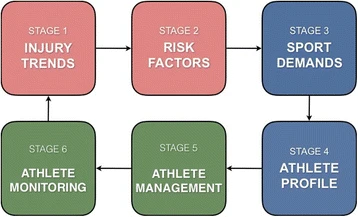
Let’s briefly explore each stage with examples of how to apply it in preseason.
Stages 1–2: Understand Injury Trends and Risk Factors
Before building your testing plan, audit your team’s injury data from previous seasons. Look at incidence, severity, recurrence, and patterns. How do your data compare to known trends in your sport or demographic?
While we can compare to norms available in the literature, it's important to be consider your specific populations. For example, research has shown differences in injury profiles between male and female footballers, with a higher prevalence of hamstring and hip and groin injuries in men compared to more quadricep strains, ACL and ankle injuries in women (Larruskain et al., 2018). This research is a bit dated now given the rapid evolution of physical demands in women's football, so it will be interesting to see how this develops with more recent research. Findings such as these should shape the physical qualities you target in screening.
Next, link injury trends to known risk factors. The “web of determinants” framework (Bittencourt et al., 2016) illustrates how risk is shaped by an interacting network of physical, psychological, and contextual factors. Physical screening can highlight status with single risk factors in isolation, but should always be considered within the complex systems context.
Stages 3–4: Profile the Sport and the Athlete
A strong testing battery is grounded in sport-specific demands. Consider:
What movements, forces, or actions define performance in your sport?
What key capacities support those demands?
What does the match and training load data tell you?
For example, Damien Harper’s work on deceleration highlights how horizontal braking is both a risk factor and a performance demand. That justifies profiling deceleration capacity and the underpinning physical qualities, which has been overlooked for a long time in team sports.
Next, zoom in on the individual. Use tools like VALD ForceFrame, ForceDecks, or Dynamo to profile joint strength and asymmetries. Visualise this data using z-scores, radar plots, or squad distribution graphs to understand where each athlete sits in relation to the squad, position group norms or their own historical data.

Stages 5–6: Monitor and Manage with Intention
It’s not enough to collect data - you need to act on it. We need to translate the information into meaning: what does each individual profile mean for their athletic development, their injury mitigation, their rehab should they suffer injury?
Roe’s framework proposes different intervention levels:
Group-based (e.g. standard warm-ups)
Clustered (e.g. position-specific or needs-based programs)
Individualised (e.g. tailored plans based on screening data)
It is these interventions that preseason testing information can help to guide.

A key question to keep asking: So what? What does each metric mean for the athlete, the coach, or the rehab team? Make data actionable.
Planning Preseason Testing with Intention
In the VALD Practitioner Guide to Preseason, we discussed the ‘5W1H’ approach for planning preseason testing. This is shorthand for “Who, What, When, Where, Why and How.” The “Five Ws and One H” model can help guide your testing plan:
Who will be tested?
What are you testing?
When will each test take place?
Where will it take place?
Why are you testing—and how will you use the results?
How will it be conducted?
This checklist ensures clarity of a preseason testing battery and when each will be conducted. It is recommended to discuss and disseminate this plan among key stakeholders, including the athletes themselves.
An example is shown in the Table below, taken from the VALD Practitioner Guide to Preseason. Please note that this is not a fixed guideline but an illustration of how the 5W1H might be used to help develop a preseason testing protocol. The specifics of each of these depend on the context of your own environment.

Even putting this plan down on paper forces clarity and focus. Don’t test something unless you can (and will) use the results. Avoid falling into the trap of testing everything “just in case.” As tempting as it is to collect large datasets, the real power lies in clear planning and prioritisation.
The Value-Burden Matrix
It is imperative that Performance staff consider the Value-Burden matrix when designing preseason testing protocols, both for the players as well as the staff themselves. As has been regularly discussed on the Global Performance Insights blog, the goal is to aim for data collection that yields high value while imposing minimal burden.
This requires careful consideration of which tests will offer the most significant return on investment.
Ideally, data should be collected through methods that are minimally burdensome for both athletes and staff, although high-burden data collection may be justified if the value is substantial, such as with blood testing, concussion testing or DEXA scans.

However, low-value data collection should be avoided, necessitating reflection and critical evaluation of the proposed testing approach.
It is essential to honestly assess how the data will benefit the team and athletes, focusing on the specific advantages it will bring rather than simply accumulating more data. Clearly outlining how this information will inform preseason interventions and beyond is paramount.
Burden includes physical fatigue on athletes and logistical load on staff. Some tests require minimal setup, analysis, and athlete effort—making them perfect for regular use. Others may only be worth the investment if they offer deep insight or shape a high-stakes decision.
Before your next testing session, ask yourself:
Did we use this information last year? Did it change how we programmed or intervened? If not, why are we repeating it?
Final Thoughts
Preseason lays the foundation for a successful year. But data collection is only as valuable as the decisions it supports.
By adopting a structured framework for injury risk and performance profiling, we can better understand the physical capacities of our athletes, design smarter interventions, and close the loop with effective monitoring.
Plan with intention. Test with purpose. Use the data.
🧪 Download the VALD Practitioner Guide to Preseason (link)
🎥 Watch the full webinar on VALD (link)
🧠 Subscribe to Global Performance Insights for more applied sport science content!
😊 Found my free content useful? Say thanks here.
FAQs on Preseason Testing
Why use an injury risk framework for physical testing?
Because many of the physical qualities we assess—like hamstring or groin strength—support both injury risk reduction and performance enhancement. The framework helps ensure testing leads to action.
How often should we re-test during the season?
It depends on the metric and the intervention. If you prescribe a program based on a test result, you should follow up within a timeframe that reflects the expected adaptation. Not all tests require re-testing, but some should be tracked regularly.
What’s the most important factor in preseason testing?
Intentionality. Know what you’re testing and why. And have a clear plan for how the results will be used to guide training, rehab, or monitoring.

If you enjoyed this, check out our athlete testing YouTube series in collaboration with VALD Performance.

This article is support by VALD Performance. For more information, about their technology, visit their website.


Comments