


Are You Ready for 2026? Key Sports Science Trends Explained

This post discusses my new video looking ahead to 2026 and the key trends sports science practitioners will face.
It's always interesting to start looking ahead to the next year and what it may bring for sports science practitioners. I've put together my Sports Science trends series over the past few years and, while sport continues to evolve, there are often similar themes.
Crucially this year, I wanted to focus on what they mean for the sports science practitioner. I hope too that some of my resources, through Global Performance Insights, help you to tackle these, with more of those coming in 2026...
With sport continuing to increase in intensity and congested schedules, sports science practitioners are tasked with making decisions under uncertainty, shaping performance environments, integrating increasingly complex information, and supporting both athlete and our own wellbeing.
In my new video, I explore five key trends that I believe will shape sports science practice in 2026 – and what they mean for practitioners on the ground. In this article, I'll share details of the first two, and for the rest you'll have to take a look at the video embedded at the end of the article!
1. AI and the Rise of Better Questions
Artificial intelligence (AI) has been a central theme in sports science discussions for several years. But in 2026, access to AI will no longer be the differentiator. Most practitioners now have experience with large language models (such as ChatGPT), and many athlete management systems and analytics tools have AI integrated within them.
The real differentiator is the quality of the questions we ask.
AI can give confident-sounding answers to poorly framed prompts, which highlights the importance of prompt engineering – not just as a technical skill, but as a thinking skill. Prompt engineering requires practitioners to clearly define the problem, apply constraints, recognise bias, and understand context. In many ways, it parallels the core skills of scientific inquiry.
As I discussed recently with Professor Greg Haff, AI does not replace expertise. Instead, it can amplify the value of expertise when the practitioner asks well-constructed questions rooted in domain knowledge.
In 2026, the practitioners extracting the most value from AI will not be those using it the most, but those using it well.
If you're still nervous about the AI revolution, take a look at my guide to getting started with AI.
2. From Metrics to Decisions: Developing Decision Literacy
We no longer have a data problem in sport – we have a decision-making problem.
Most teams now have more data than they can meaningfully interpret. Dashboards are full, automated reports are common, and metrics are abundant. The challenge lies in understanding how to make decisions under the inherent uncertainty present in sport.
Decision literacy requires practitioners to:
distinguish signal from noise
understand thresholds and consequences
appreciate limitations in data collection
recognise that inaction is sometimes the appropriate response
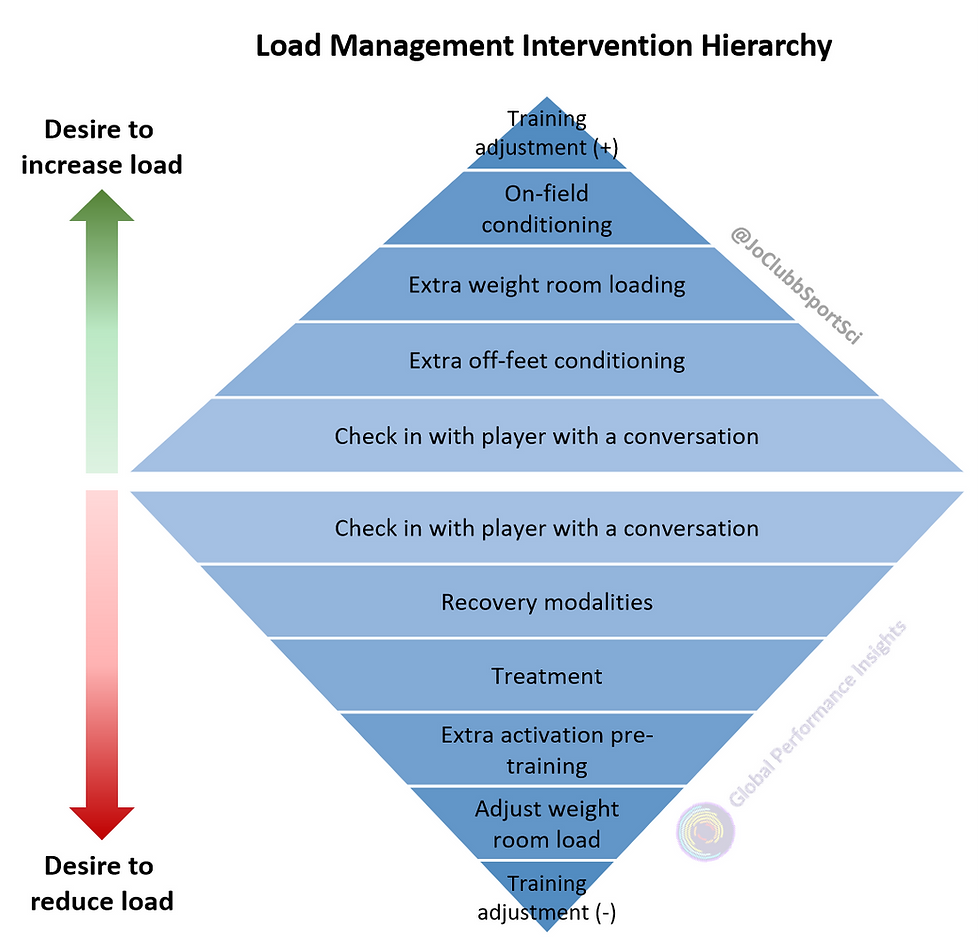
This is most clear within load monitoring, where the real value lies not in collecting data but in knowing what to do with it. In my Fundamentals of Load Monitoring course, I emphasise the “so what?” – the ability to translate information into meaningful action.

A useful example is the load management intervention hierarchy (below), which acts as a menu of possible adjustments depending on the desired training load outcome. To select appropriately, practitioners must combine data, context, expertise, and communication.
In 2026, those who excel will be the practitioners who can move beyond metrics and make informed, timely decisions under uncertainty.
Discover the Trends in Full...
So, those are the first two trends in full. The final three trends are listed below and to see each discussed in more detail, take a look at the video from the Global Performance Insights YouTube channel, below:
3. Beyond Physical Load: Understanding Psychosocial Demands
4. Women’s Sport: Moving Beyond Biology to Systems and Sociology
5. Practitioner Career Sustainability
Final Thoughts
These five trends highlight how our profession continues to evolve. Sports science in 2026 is not only about collecting data or running tests. It is about asking better questions, making better decisions, shaping environments, and supporting the wellbeing of athletes and staff alike.
With the growing interest in freelancing, consultancy, and hybrid roles, many practitioners are also reassessing what a sustainable and fulfilling long-term career looks like. This is an area I will be developing more resources around throughout 2026, to better support those navigating careers both inside and outside elite team environments.
Sustainable performance isn’t just for athletes – it applies equally to the people supporting them.
Explore more of the resources discussed in this video:
Explore the previous Sports Science Trends videos:


Comments